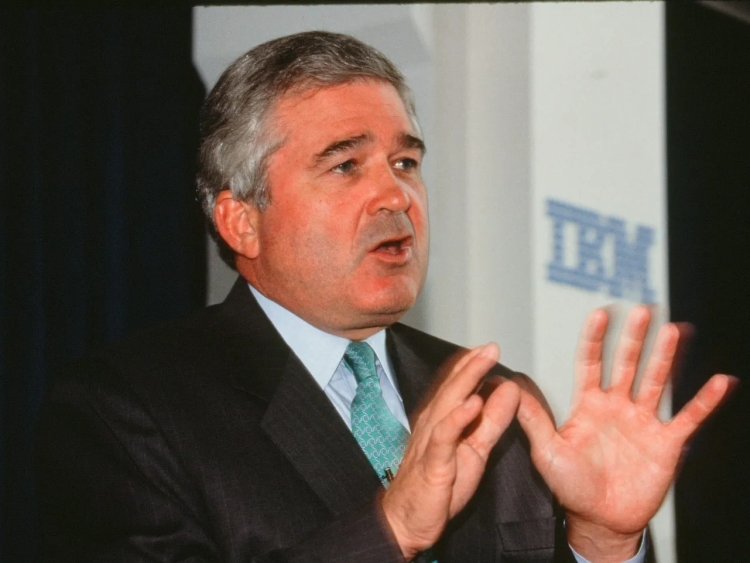
Gerstner took charge in 1993, with Big Blue bleeding cash and facing breakup or bankruptcy. He hauled it into a services-led shape that mattered again by 2002. Plenty of big-name tech types did time at IBM during his reign and carried those habits into today’s boardrooms.
Gerstner was IBM’s first chief executive hired from outside the company, and so far the only one. When he arrived in April 1993, the previous boss wanted to split IBM into semi-independent units to fight rivals without corporate baggage.
Gerstner went the other way and kept IBM as one integrated outfit, with a serious R&D engine, while tearing up how it worked day to day. The key technical shift was to ditch hardware-first economics in favour of business services, systems integration, and enterprise software.
Under his watch, IBM dropped the old habit of bundling IBM PCs with mainframe operating systems and proprietary apps that customers had already been side-eyeing in the 1980s. Those products were haemorrhaging relevance in the 1990s, so they got pushed aside.
Lines that could not win market traction were dumped, including the Token Ring LAN kit, leaving only the survivors. After OS/2 was binned, IBM played a neutral integrator, backing mixed hardware and software environments rather than forcing customers into a proprietary pen.
PCs stopped being strategically important, setting the stage for the eventual sale of the PC unit to Lenovo in 2004. Even as hardware slipped from the spotlight, IBM tightened processes and supply chain discipline to make the remaining kit business steadier.
Keeping Biggish Blue together meant it could still sell complete IT solutions because it owned components that rivals did not. Its database software, transaction-processing systems, and management tools sat between hardware and applications, nudging customers towards IBM hardware without dragging OS/2 along.
IBM leaned into the internet, enterprise networking, servers, and services in the 1990s, forerunners of what we now call cloud computing. That strategic reset came with sweeping operational change, and Gerstner did not do it gently.
He sold real estate, slashed costs hard and eliminated 35,000 jobs from a workforce of roughly 300,000. Pay was rewired to match overall corporate performance, not divisional scorekeeping, while accountability shifted from annual reviews to continuous tracking.
Despite the brutal pruning, IBM returned to growth through the 1990s. By 2002, the workforce had grown to 315,000 to 320,000, which is more than the company employed when Gerstner took over.
During his nine-year tenure, IBM’s market capitalisation rose from about $29 billion to roughly $168 billion, even after the dotcom crash in 2000 and the 11 September 2001 attacks. When he stepped down in 2002 and handed the baton to Sam Palmisano, IBM had been rebuilt into a unified, services-driven outfit.
He later chaired Carlyle Group, but the IBM reinvention is the one people keep pointing at. That culture, built around what customers would need next, was copied by plenty of high-tech firms that fancy themselves modern.
A string of current senior executives did their IBM stints during the Gerstner years, including the Fruity Cargo Cult Apple, chief executive Tim Cook; AMD, chair and chief executive Lisa Su; and AMD, chief technology officer Mark Papermaster. Add Cadence, chief executive Anirudh Devgan, IBM, chairman and chief executive Arvind Krishna, former IBM chief executive Gina Rometty, Microsoft, chairman John Thompson and chip designer Jim Keller.
IBM churned out a fair slice of today’s US tech leadership in semiconductors, enterprise, software and supply chain work, and not many companies can say that with a straight face. Former IBM staff have been piling in with tributes as news of Gerstner’s death spread.
IBM chairman and chief executive Arvind Krishna wrote, "I am saddened to share that Lou Gerstner, IBM's chairman and CEO from 1993 to 2002, died yesterday. Lou arrived at IBM at a moment when the company's future was genuinely uncertain. The industry was changing rapidly, our business was under pressure, and there was serious debate about whether IBM should even remain whole. His leadership during that period reshaped the company. Not by looking backwards, but by focusing relentlessly on what our clients would need next."
AMD, chair and chief executive Lisa Su wrote, "I was privileged to learn and experience the leadership of Lou Gerstner early in my career at IBM. He was amazingly curious and insightful about technology. So honoured to have had a chance to work with him. My condolences are with Lou's family and the extended IBM family."
Former IBM chief executive Gina Rometty wrote: "Yesterday, we lost Lou Gerstner, IBM's iconic and legendary CEO from 1993 to 2002. Lou was my very dear friend and mentor. Much will be written about Lou's immense contributions to IBM and his philanthropic efforts, but I would like to speak about Lou the person. I first met Lou in the 1990s and immediately admired him. He was a brilliant, principled leader who led with intellect, not fear. Lou could cut through to the heart of any issue with penetrating questions. One of the most valuable things he taught me was the importance of preparation. Not long after we met, we were getting ready for a client meeting when Lou told me that he’d been reading a book, The Greatest Generation, because it included a chapter on the CEO we were going to visit. I couldn’t believe he was researching so diligently, and I thought, 'if the CEO takes time to prepare, so should I."