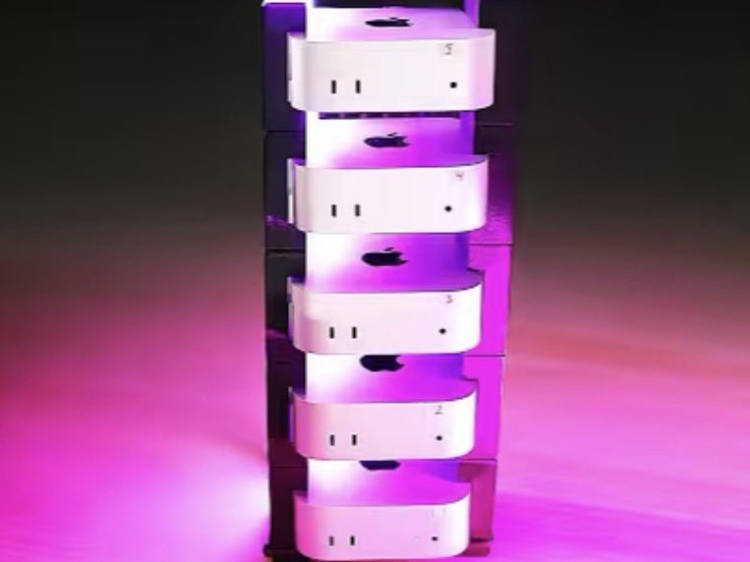
Memory, right now, is worth its weight in gold, and clustering Mac mini or Apple Studio boxes with unified memory lets the CPU and GPU draw from the same pool, ironically making it cheaper than rivals.
But even as Job’s Mob rolls out tools to milk this setup, its competitiveness is being eroded by expiring memory-focused long-term agreements.
Those LTAs are running out, and the timing is grim with higher prices looming for upcoming kits like the M5-based Mac mini and Apple Studio.
The AI edge around clustered Macs has already been touted by developer Alex Ziskind, who showed it was cheaper to run modest ML and AI jobs on Apple silicon than on an Nvidia RTX 4090.
That cost gap exists because Apple silicon shares memory between the CPU and GPU, meaning an M4 Pro Mac mini can access 64GB of unified memory, compared with the RTX 4090’s 24GB.
Link several Mac minis together over Thunderbolt 5, and the available memory scales rapidly, which is catnip for AI workloads.
Job’s Mob has been keen to trumpet this pooled computing trick, especially with more powerful M5-based machines waiting in the wings.
macOS Tahoe 26.2 added a new driver to MLX, Apple’s in-house machine learning platform, bringing Thunderbolt 5 support into the mix.
Compared with Ethernet clusters that top out around 10Gb/s, Thunderbolt 5 pushes up to 80Gb/s and supports Remote Direct Memory Access.
RDMA lets one node read another’s memory without chewing up CPU cycles, making the whole cluster far more efficient.
YouTuber Jeff Geerling recently demonstrated the idea by building a cluster of four Apple Studios loaned by Job’s Mob. The setup delivered roughly 1.5TB of unified memory and cost about $40,000.
To match that memory by clustering Nvidia DGX Spark boxes would require 12 units at roughly $4,000 each, or $48,000 in total. That left Geerling’s Mac cluster with an $8,000 edge, for now.
A big chunk of that saving comes from Job’s Mob’s long-term memory supply deals with the usual DRAM giants.
Some of those agreements expire as soon as January 2026, with Samsung and SK hynix keen to jack up prices once the ink runs out.
When that happens, the neat $8,000 advantage could shrink to loose change or vanish entirely, leaving Apple’s shiny clustering story looking a lot less clever.